
Free Estimate
Concrete Pool Decks in Northwest Arkansas
A pool deck has to do more than look finished. It is walked on barefoot and wet, which makes slope, drainage and surface texture functional requirements rather than preferences.
The problem homeowners describe
Pool decks come up in two situations: a new pool that needs the surrounding area finished, or an existing surround that is cracked, holding water, or uncomfortably slick when wet. The recurring problem is water. A pool deck that drains back toward the pool, or toward the house, or into a spot that stays permanently wet, will be unpleasant to use and will deteriorate faster through freeze-thaw. The second recurring problem is texture: a finish chosen purely for looks can be genuinely unsafe underfoot when wet.
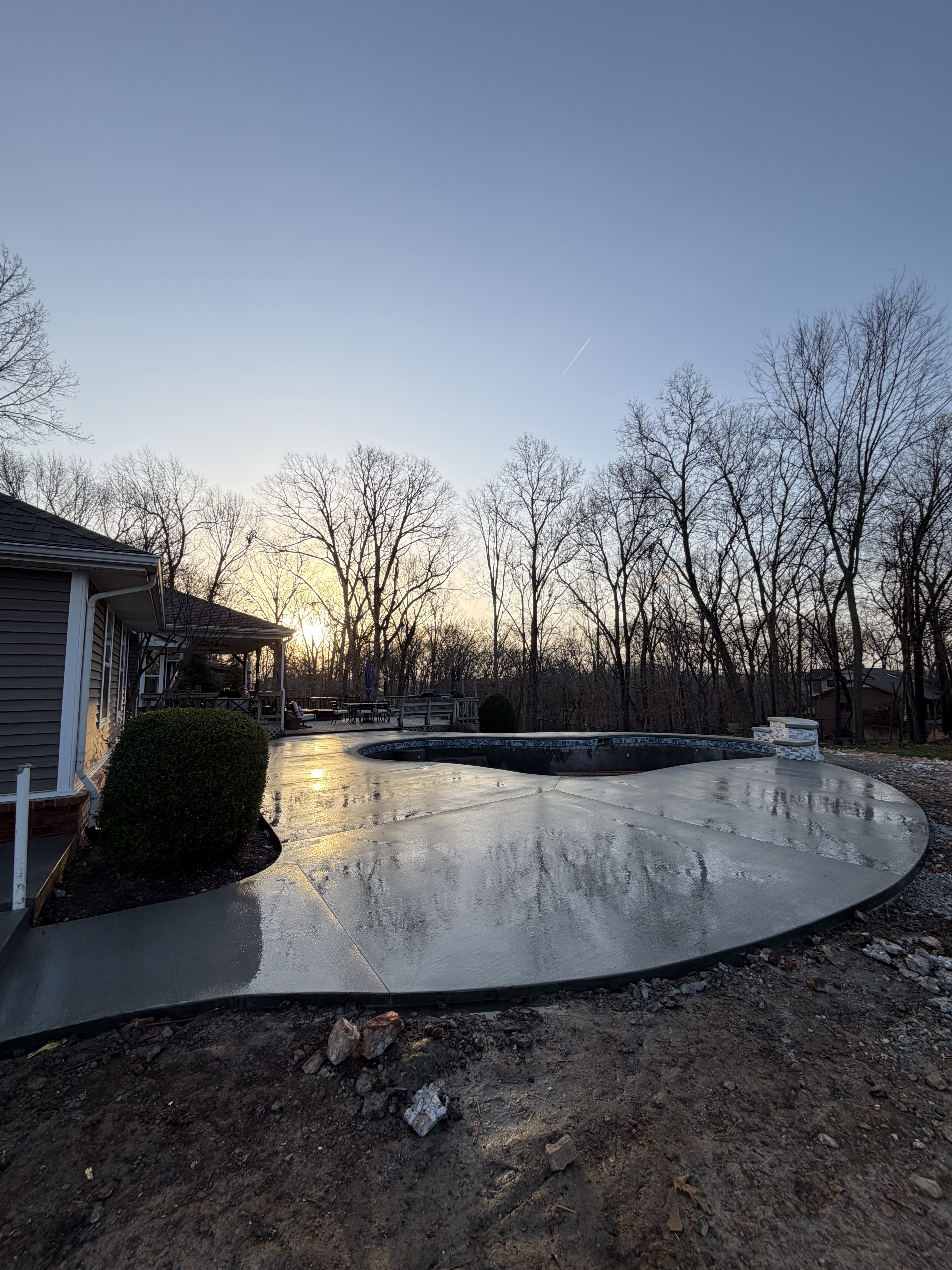
From a recent job
How Natural State builds it
- Walk the pool area and confirm the deck footprint, including access points and any coping-adjacent work.
- Establish where water needs to go and set the drainage plan before anything is formed.
- Excavate and remove existing concrete where present.
- Grade and compact the base to consistent support.
- Set forms, confirm slope away from the pool and the house, and place reinforcement.
- Pour, screed, float and apply a traction-appropriate finish.
- Place control joints in a layout that suits the deck geometry around the pool.
- Clean up and walk the finished deck with the homeowner.
Site preparation
Base preparation around a pool has to account for ground that may have been disturbed during pool installation. Backfilled areas are not automatically well compacted, and building on uncorrected fill is a reliable way to get settlement later. Soft areas are excavated and corrected rather than bridged.
Reinforcement
Pool decks are usually large, irregularly shaped, and full of inside corners where the concrete wraps around the pool. Those corners concentrate stress. Reinforcement is specified for the geometry, and joint layout is planned around the shape rather than applied as a uniform grid, so shrinkage relieves itself along planned lines instead of through a corner.
Drainage and slope
This is the defining detail of a pool deck. The surface has to shed water away from the pool and away from the house, and the water has to have somewhere to go once it gets there. Slope is set during forming and verified before the pour, including at transitions where the deck meets coping, steps or existing flatwork — the places where a low spot is easiest to create by accident.
Finish options
- Broom finish — the standard around water for traction when wet.
- Smooth-troweled borders with a broomed field, keeping traction where people walk.
- Decorative banding to define the deck edge without creating a slick surface underfoot.
What affects the timeline
- Deck size and how much of the pool perimeter is being wrapped.
- Whether existing decking has to be removed first.
- Condition of the ground around the pool and how much base correction is required.
- Access to the pool area for equipment and concrete delivery.
- Weather during placement and curing.
What affects cost
- Square footage and the complexity of the shape around the pool.
- Tear-out and haul-off of existing decking.
- Base correction where ground was disturbed during pool installation.
- Reinforcement specified for the geometry.
- Access to the pool area.
- Finish selection and any decorative edge treatment.
- Drainage work where water is currently mismanaged.
Every site is different, so pricing is quoted after a walkthrough rather than published as a fixed rate.
Northwest Arkansas site considerations
Northwest Arkansas sites bring their own constraints. Much of the region sits on rocky, uneven ground with clay-heavy pockets, so base depth is rarely uniform across a single pour. Sloped lots in and around Rogers, Bentonville, Bella Vista and Goshen mean water has to be planned for deliberately rather than assumed. Freeze-thaw cycling through winter is the other factor: concrete that holds standing water and then freezes will deteriorate faster than concrete that sheds it, which is why slope and jointing get as much attention as the pour itself.
Common questions
Is concrete slippery around a pool?
It depends entirely on the finish. A broom finish provides texture that gives traction when wet, which is why it is the standard choice around water. A smooth-troweled surface looks cleaner but is not appropriate underfoot in a wet area.
Which way should a pool deck drain?
Away from both the pool and the house, toward somewhere the water can actually go. Draining back into the pool or into a spot that stays permanently wet causes problems that are difficult to correct after the fact, so the drainage plan is settled before forming.
Can you pour a deck around an existing pool?
Yes. Working around an existing pool is common. The main considerations are how the new concrete meets the coping and whether the ground around the pool was well compacted after installation.
Can you replace a cracked pool deck?
Yes. Tear-out and replacement is part of the work. Where the existing deck failed because of drainage or base problems, correcting the underlying cause is what stops the replacement repeating it.
What areas do you serve?
Natural State Concrete works across Northwest Arkansas, including Rogers, Bentonville, Springdale, Fayetteville, Bella Vista and Goshen.
Ready for an estimate?
Send a few photos and a short description of the project. Natural State Concrete serves Rogers, Bentonville, Springdale, Fayetteville, Bella Vista and Goshen.
Explore other services: Concrete Driveways, Concrete Patios · All services